Showing posts with label Onsen. Show all posts

Friday, February 13, 2009

Hakone

The view of Mount-Fuji over Hakone Lake is one of the picture-postcards of Japan. As every tourist spot in the country, Hakone can get overcrowded. People who lined-up for two hours to board the cable card will indeed have a bad memory, especially if they were rewarded with a view on … the clouds in front of the famous volcano. However, outside of the busy period and if the weather is fine, Hakone will be an unforgettable trip only one hour away from Tokyo: the volcanic activity, outstanding views and pleasant hikes will make the perfect getaway to forget about Tokyo. Hakone is a nice place to spend a night. It should be part of any trip of Kanto (Tokyo region) that could also include Nikko, Kamakura, a trip in the mountains and the Izu peninsula.
There is plenty to see and do there, but the trip from Tokyo is also interesting in its own right. The “Romance Car”, a special service of the Odakyu company, offer a few panoramic seat with a direct view on the railroad (the driver’s cabin is elevated in order not to spoil the view). As the train goes through the whole Tokyo suburbs from the major urban center of Shinjuku, this is probably one of the best ways to get an overview of the city. High-rise buildings soon make the way for ordinary suburb condos, with a surprising number of detached houses even close from the city center. Near every station, the urban density increases, with more condos and commercial buildings. There are only a few rice or vegetables fields at first, but at some point, they occupy most of the land, and the typical Japanese countryside landscape appears: small rice fields and always some hours nearby. After crossing a few hills, the train crosses the small town of Matsuda (松田), and Odawara (小田原), before making its way through a narrow valley to Hakone Yumoto (箱根湯本).
Hakone Yumoto is a trendy hot spring (onsen) station from where the Hakone-Tozan (箱根当山) train starts. You may wish to enjoy the Fujiya “Classic Hotel” near Miyanoshita station (宮ノ下駅), which is also an outstanding place just to have a drink or a tea, and you may want to go there just to buy the “Curry Pans”, with a reputation as some of the bests in the country. This is a much quieter place than Hakone Yumoto. Gora station (強羅駅), the final station of the Hakone-Tozan line, is also a nice place to enjoy onsens. There are many isolated hamlets around with one of two onsen hotels for those of you who prefer to be surrounded by nature. If this was not enough for you hotspring-wise, the Izu Peninsula is only a few minutes train from Odawara, especially Atami station, which is now back in fashion.

Hakone is located in a collapsed crater of a volcano, and the famous lake is the lowest point of the resulting “caldeira”. The last eruption was 3000 years ago, and created the lake Ashinoko (芦ノ湖) and the Owakudani valley. Between Hakone Yumoto and Ashiko lake, Owakudani (大涌谷) looks like Hell's gate. Sulphurous smoke gets out from the ground, and there are numerous hot springs. This being Japan, a special souvenir food was created for the place: Black eggs « kurotamago » (黒玉子), are boiled in volcanic smoke. They are supposed to make life 7 years longer if eaten with moderation, a very convenient custom to increase sales. You can reach Owakudani from the cablecar and the ropeway from Gora.
The main reason to come to Hakone is for the outstanding views of Mount-Fuji. They are at their most impressive between the end of Autumn and the start of Spring, when the mountain is still covered with snow, and the weather clear enough to see he volcano. One of the most pleasant places is a garden located on the site of a former imperial residence (onshi-hakone, 恩賜箱根) in a small peninsula halfway between Moto-Hakone (元箱根) and Hakone-machi (箱根町). Following the standard tourist itinerary, Moto-Hakone can be reached from the boat starting near the cable car terminal at Togendai (桃源台). One should be prepared for a reproduction of a French ship of the line, or a Mississippi steam boat, and should remind that eclectics is a very important part of Japanese culture. Once in Moto-Hakone, the garden can be reached by a pleasant 15 minutes walk in a very pleasant alley bordered by old pine trees following the lake shores. This is a section of the historic Tokaido road. After visiting the garden, you can continue your walk on the road heading to Hakone-machi, and you will find the old custom gate of Hakone (HakoneSekisho, 箱根関所). This used to be the entry of the Kanto (literally meaning “east of the gates”) region, and could not be crossed without a special permit. The control of domestic travel was one of the bases of the power of the Tokugawa shogun, who ensured he always had hostages from all the warrior clans in the capital to guarantee internal peace.
From Moto-Hakone, a pleasant trip is the old Tokaido road, called Kyukaido (旧街道), which goes down the mountain to Hakone Yumoto. As may hikes in Japan, it is a pleasant way to enjoy the forest which covers this narrow valley. Hiking boots are compulsory. It can be surprising that the main road of ancient Japan was so narrow, but ancient roads, such as the famous Roman roads, were never actually used to move goods, as this was very costly: business was made by boats on rivers and sea, so roads were used only by travelers and by the army. After one hour of walk, you will come across Amasake-Chaya (甘酒茶屋) which offers welcome warm “sake”, and a small museum presenting the old Tokaido road. After 45 additional minutes, you will reach the small Hatajuku (幡宿) village, which is specialized in wooden boxes, of course sold in many souvenir shops. From the village, you can continue the walk down to Hakone Yumoto (which would take half a day in total), or take the bus to the village.

Practical Information

The Romance Car will set you back Yen 2020 from Shinjuku to Hakone Yumoto, there are approximately two trains per hours. A “free pass” is available to non-residents for Yen 5000 (38 Euros) for 2 days or Yen 5500 (42 Euros) for three days. The company site gives detailed information in English: http://www.odakyu.jp/english/rc/index.html

The classic tourist itinerary from Hakone Yumoto includes the Hakone Tozan train from Hakone-Yumoto to Gora (Yens 390 one-way), then the Hakone-Tozan train to Sounzan (早雲山), and the cable-car (Hakone Ropeway, 箱根ロープウェイ) to Togendai (桃源台) (Yen 1330 (10 Euros) one way, Yen 2340 (18 Euros) return).

Although the trains and cable cars are pleasant, the most convenient way to reach Moto-Hakone is the bus : 40 mintes from Hakone Yumoto (Yen 930 (7 Euros) one way).

Summer should be avoided, as Mount-Fuji will certainly be hidden by the mist. Official Japanese holidays will bring great crowds, so Hakone is also better avoided at that date: golden week from April 28th to May 5th and New years holidays around January 1st.

This map provided by the Japanese tourism Information Bureau is very convenient: http://www.jnto.go.jp/eng/map/009_Hakone.html


The « Secret Japan » site gives many useful tips on hot springs in the region: http://www.secret-japan.com/forum/hakone-(kanagawa-ken)-t18.html

The official Hakone site lists 17 onsen hot springs. (http://www.hakone.or.jp/english/midokoro/onsen.html)

The woodprint shown here is issues from the “53 stages of Tokaido” (東海道五十三次) series from Utagawa Hiroshige (歌川広重)

You may want to continue reading and organizing your trip with those stories about “Classic Hotels”, “Onsens” and the “Izu Peninsula”.

Full Story

Sunday, July 6, 2008

The most outstanding view in Kansai

Japan is a mountainous archipelago. More than two third of the land are made of abrupt moutains covered by forest. There are sometimes only a few hundred meters of plain between the hills and the sea for humans to settle. I suggest we leave today for the “Rokko-san” (六甲山) range near Kobe (神戸) to get a spectacular summary of Japanese geography, and to enjoy the most beautiful panorama in Kansai (関西). You may want to end the trip in the hot-spring resort of Arima (有馬), probably the oldest in Japan.
For the less brave, a ropeway leads to the top of the moutain range. The observation platform near the upper station is worth a few minutes to enjoy the outstanding view of Kobe harbor. A bus then allows you easy access to the main tourist attractions. You may also want to hike you way to the summit. Departure of the trail is near the ashiya-gawa (芦屋川) station on the Hankyu Kobe (阪急神戸線) line. You should first follow signs to the « Rock Gardens » (ロックガーデン), then the well-mark track to the summit of Rokko-san. You will spend around 5 hours to climb and go down to Arima onsen. As always when hiking in Japan, you should be adequately equipped.
Mount Rokko is a climatic resort since 1895, when a British resident, Arthur H Gloom, installed a mountain hut near the summit. The place developed then as a resort where residents could enjoy the cool weather. The mountain is an important part of the city identity: the song of “Hanshin Tiger” (阪神タイガー) baseball team is “Rokko Oroshi” (六甲颪) or “The wind of Mount Rokko”. According to Hanshin fans, it is best song after a few beers during an outstanding victory against the Yomiuri Giants (読売巨人), the rival team from Tokyo.
The place has all the usual spots of Japanese tourism. The “Rokko Garden Terrace”, a replica of an European village, is a cluster of trendy shops. It even includes a castle tower, with a wall that reminds more of Japanese suburban houses than of Scottish castles. Rokko-san is also famous for its sheep farm, where local cheese is made. A restaurant near the “Rokko Garden Terrace” of course offers the “Genghis Kahn”, a mutton stew. The oldest golf of Japan was also built nearby, and you may enjoy the botanical garden and the “Country House” that also includes an artificial ski run.
More than the tourist spots, the most pleasant is the wonderful view from the mountain. The terrace at “Rokko Garden Terrace” is a wonderful place to watch Kansai from above. The panorama extends from Kobe to Osaka, with the sea in the background, just a few kilometers away. If the sky is clear, you may also see the Kansai International Airport built on a man-made island. This is a huge metropolis, with concrete as far as the eye can see, but high rise buildings are few and far apart. The Japanese cities are often chaotic: heterogeneous buildings are gathered randomly, with the exception of downtown Kobe, an area that was rebuilt after the earthquake. Reclaimed land area is visible all along the shore. In Kobe, two large man-made islands were built, “Rokko island” and “Port Island”. With the long recession, not all of this expensive land is used. During the earthquake, they proved especially unstable due to the high amount of water in the ground. This did not prevent the city from building an airport on reclaimed land, even further off the shore than Port Island.
Once you enjoyed the view, you may want to come back to Kobe through the other side of the moutain. A cable car will get you to the Arima. The 12 minutes trip above the forest is very pleasant. Once in Arima, you may want to go back to Kobe, but you may also spend a few hours enjoying the hot-springs. There is a legend that a 7th century emperor stayed several months there to enjoy the bathes. The town had ups and downs, and was almost destroyed by a major landslide in the 11th century. It was rebuilt by General Toyotomi Hideyoshi during the 16th century, and has thrived ever since. Two public bathes, “Kin-No-Yu” (金の湯) and « Gin-No-Yu » (銀の湯), can be visited during the day. There are many ryokans if you want to stay overnight.
Access to Mount Rokko

The « Rokko Cable car » goes all the way to the summit of the range. The departure station is close from the “Rokko” train station on the Hankyu line. One way ticket: Y570 (3.45 Euros), return ticket Y1000 (6 Euros). A return and summit bus ticket « Omote Rokko Shuyu Joshaken » is also available for Y1300. Access to the cable car is easier by bus 16 from the Hankyu « Rokko » station and JR “Rokko-michi” station.

« Rokko Arima Ropeway » links Arima station to the summit. Ticket is Y980 (6 Euros) one way, Y1770 (10.80 Euros) for a return ticket. A formula including the summit bus “ Ura Rokko Shuyu Joshaken” costs Y1900 (11.52 Euros).

A one way ticket from Kobe to ARima including the cable car, the summit bus, and the ropeway called “Rokko Arima Katamichi Joshaken” will set you back Y1700 (10.30 Euros).

You may return from Arima to Kobe using the Shintetsu (神鉄) train line, with a transfer in Arimaguchi (有馬口), and then a transfer in Tanigami (谷上) to the Kobe subway. The trip to Sannomiya (三宮) costs Y900 (5.45 Euros) for 30 minutes of train.

Kin-No-Yu: Admission Y650 (4 Euros), opened from 8:00 to 22:00, closed every second and fourth Tuesday of each month.
Gin-No-Yu: Admission Y550 (3.3 Euros), opened from 9:00 to 21:00, closed every first and third Tuesday of each month.
Full Story

Monday, June 30, 2008

Romantic week-end in an onsen

Japanese urban life is certainly exciting, but one sometimes feels the need of a break. In this hard-working and crowded country, there is an ideal getaway to forget the stress of urban life for the time of a short week-end. Whether you wish to rest after an intense week of work, have some private time with your special one, or enjoy a friendly family outing, Japanese traditional inns (旅館, ryokan) will welcome you for a night. Most of them are located in hot-spring resorts, and offer bathes in natural hot water (温泉, onsen). More than an accommodation, ryokans offer a show, a travel in an idealized traditional Japan.
Starting from the main cities, you can reach hot-spring resorts in one or two hours. They come in all size and various degree of refinement. The mass-market Kinugawa-onsen (鬼怒川温泉), a few kilometers away from Nikko(日光) was built in a modern style that would not be out of place in the suburbs. The smart Shuzenji-Onsen (修善寺温泉), 90 minutes away from Tokyo gathers luxury inns, some of them comparing well to the most beautiful wooden temples of Japan. Isolated Ryokans also propose a friendly rest in isolated places. The very convenient resort of Atami (熱海), just 50 minutes away from Tokyo looks like a small Monaco, with its large buildings on the slope of the mountains by the sea.
A week-end in a “Onsen” starts on Saturday morning in the station or the car rental agency. You will then leave the city. You may want to have a nice lunch and one hour of sightseeing on the way. Travelers on their way to Shuzenji may enjoy a well-deserved rest in Mishima (三島) to taste the local eel (うなぎ, unagi). Hosts to the Kinugawa onsen resort may enjoy climbing the local mountain by foot (山頂) or cable-car. It is recommended to reach the ryokan by mid-afternoon. Their architecture is very diverse: some of them are wooden buildings in traditional Japanese style, old or recent. Others are very modern-looking hotels with concrete walls shamelessly exhibited. You should not let the outside appearance repel you, as the service at those hotels is usually outstanding. Some of them may even offer a traditional service in a tatami room. And once inside, you will not care about those ugly concrete walls.
You will be warmly welcome by the house staff, in traditional attire. They will lead you to your room. Some of them are Japanese style (和室), with tatami floor and wooden walls. The traditional service includes the meals served in the room. The table is then put aside, and the traditional Japanese bed is brought out of the closets: it is made of a mattress on the floor and a duvet (布団, futon). This formula has some drawbacks: the guests are often disturbed by the staff, first around 6pm to set the dinner table, then to put the table away and install the bed, and early in the morning (7 or 8am) to install the breakfast table. Some western style rooms (洋室), with a meal served in the restaurant are also available, but have less appeal, and the restaurant is less suited to private discussions. Most young Japanese enjoy the serenity of traditional Japanese rooms, but do not wish to be disturbed. This is why most modern onsens have a “mixed” formula, probably the most pleasant: guests can enjoy a Japanese style room, with a small alcove containing western style beds. Meals are taken in a private space separated from the room.
Once installed in your room, you will be served a small sweet and green tea. The staff will discuss with you as if you were a long time guest. If the buildings have an interesting history, it will be explained in details. Do not be surprised if the staff calls your husband (旦那さん, dannasan) or "your wife" (奥さん, okusan) the date from 3 days ago you bring with you there. Once alone in the room, you will change to the yukata (浴衣) provided, a cotton dressing gown that will be much more comfortable than your travel clothes. If you look like a rugby player, the staff will do its best to bring you the only « extra long » (特大Tokudai) yukata they have. It is perfectly acceptable to wander outside your room wearing the yukata. As you are now ready to go to the bath, you should put your valuables in the safe of the room, or in your luggage. Then, you will put your room key, and your towel in the small bag provided.
The traditional collective bath has separate spaces for men (indicated by a blue colour and the sign 男) and women (indicated by red and the sign 女). Moth bathes use traditional materials: stone, wood, and bamboo. The simplest bathes are small square pools in wood or stone less than a meter deep and wide enough to stretch the body inside. The room wall may be decorated with a paint of various artistic qualities. Some bathes are small stone pools looking like a small natural pond, artistically integrated in the landscape. This is not just a bath, but a show. The first step is to thoroughly wash yourself in the showers adjoining the bath, then to enter the bath naked. You may want to hide some parts of your body with the small towel provided until you enter in the water. Anyways, the chance is you will not think about it anymore after a few seconds. The bath water is often very hot, and, after a few minutes, you should exit and cool down. There is sometimes a cold water pool nearby for that.
Outside bathes (露天風呂, Rottenburo) are the most pleasant. They often offer a pleasant view on the surroundings. The contrast between the hot water and fresh air is ideal. Even when the outside temperature is negative, the warmth accumulated in the hot bath will allow you to stay naked outside for a few minutes without feeling the cold. The writer of this story has unforgettable memories of a bath in a rottenburo under the snow. Private bathes can also be booked, often for half an hour, without an extra fee. They allow a fun and intimate bath. In some ryokans, a private bath on the balcony is also available. This is probably the most pleasant formula, but is slightly more expensive. Whatever the formula, the greatest pleasure of the onsen is after the bath. The whole body relaxed by the bath, it is very pleasant to wander in the hotel, have a tea, and slowly read a well chosen book in its room, while enjoying the subtle tatami smell. There is always a sweet and tea available for this moment.

The dinner is served at Japanese time, from 6 to 9pm. Several dishes are served. The meal makes the best of seasonal and regional ingredients that will be explained in detail by the staff. All the dishes are elegantly set. Classical examples are small wooden boats on which sashimi (刺身, sashimi) is served, and food served on bamboo. The plates are always in traditional Japanese style. Very often, enjoyable « cook-it-yourself » dishes are part of the menu. Meat to cook on a hot plate, or tofus cooked on the table are common. There are also many pot dishes (鍋, nabe) heated on the guest table. Japanese sake and beer are always available, and a reasonable price even at the most expensive places. There is often enough time after dinner for a second hot-spring bath. Alcohol and the hot water will ensure you will sleep very well. Breakfast is served between 7 and 9am, and is made of sweet and salty regional delicacies.
After a last bath in the morning, departure is quite early. There is enough time left in the Sunday to perform ambitious sightseeing. From Kinugawa-onsen, it is possible to go to Nikko. Izu Peninsula (伊豆半島) and Hakone (箱根) also offer first-class tourism. A car is very convenient to go to remote places as countryside buses are expensive and infrequent. However there will be awful traffic jams on Sunday night on the roads back to the cities. Public transport is less convenient for sightseeing, but reserved limited trains are a very convenient way to go back home in style. From the train window, the landscape will become more and more urban, the neon’s will be brighter, and after crossing a few rivers, the trip will only end on the train station, back to daily life.
Onsen resorts close from Tokyo and prices

In Tokyo areas, the most accessible areas are:
  • Izu peninsula: the towns of Atami, Ito, Shimoda, Toi and Shuzenji cluster many onsen ryokans. There is much sightseeing available in a scenery mixing the sea and the mountain;
  • Hakone: this mountain resort close to Mount Fuji is a first-rate sightseeing spot, with impressive volcanic fumes, and the beautiful lake on which Mount Fuji reflects. Odakyu Line offers reserved limited train services (1h31, Y2020 - 12.6 Euros) to Hakone Yumoto (箱根湯本)
  • Southern Alps are the highest mountains in Japan. A car is necessary to reach those remote valleys, and on the way, the Fuji five lakes will make a memorable stop. Onsens are often in remote places. It is better to avoid returning to Tokyo by the “Chuo” motorway (中央高速道路) on Sunday night. It is common to spend 5 or 6 hours to come back to the city;
  • Kinugawa-onsen: the Onsen “Costa Brava”: easily accessible from Tokyo, this resort gathers large hotels built around a river canyon: the atmosphere is quite urban, but the service offered by the hotels is often of good quality. The superb temple complex of Nikko is only a few minutes train away, and will make an unforgettable week-end. Access through the special reserved Tobu “Kinu” train (1h57, Y2800 - 17.5 Euros)
Le The “non-profit” independent site Secret Japan is a huge database about onsens, with explanations in French or English.
Prices vary with the quality of service and prestige. They are always higher on week-end.
The “Biwa” ryokan (枇杷) in Toi (土肥) is offering a two-meals and night formula with a massage included for around Y75.000 (470 Euros) for two people on weekdays, and Y95.000 (600 Euros) on week-end. The hotel is new, but built in the traditional way, with wonderful wooden “pouters”. Each room has a private rottenburo bath on the balcony, with a view on the sea and the city. Food is excellent, and served in an individual space. Address: 静岡県伊豆市土肥259-1 Toi Izu-shi Shizuoka-ken. Tel 0559-97-3124. Access to Toi: ferry from Shimizu, bus from Mishima or Shuzenji.
The hotel “Asaya” in Kinugawa-onsen has several hundred rooms, and offer two-meals formula with Japanese dinner at the restaurant, large (15 tatami) japanese room, and all-you-can-eat breakfast for 42500 Yens (250 Euros) on weekdays et 47000 Yens (300 Euros) on week-end for two. Entrance to the bath, including a rottenburo on the roof, is included. There are less expensive formulas in the hotel. Address: 813 Taki – Kinugawa Onsen, Nikko-shi, Tochigi-ken 321-2526 栃木県日光市鬼怒川温泉滝813Tel : 0288.77.1111. Direct Access from the Tobu Asakusa station in Tokyo by the trains of the Tobu company.
Both Ryokans can be booked through Yahoo Japan Travel.

Full Story

Saturday, April 5, 2008

On the tracks of the Izu Dancer

I may not be the only one to have been introduced to Japanese literature by the short “Izu Dancer” (伊豆の踊り子) novel. It tells the story of a young high-school student going on a vacation trip to the Izu Peninsula (伊豆半島) in the early 1900s. He starts the trip alone and sad. Later, he meets a group of entertainers and travels with them down to Shimoda(下田). His mood gets a lot better, thanks to his cheerful company and especially the attraction he feels for a young dancer. The young age of the girl and the gap in social status will not allow him to have an affair, but our hero leaves for Tokyo from Shimoda by boat with much lighter feelings. The story is gracefully told by Kawabata’s elegant prose.
During my first trip to Japan, I ran into Izu Peninsula again when I looked for a quick “onsen experience” outside Tokyo. This brought me to Atami (熱海), the gateway to the Peninsula, and a popular modern resort. Being on budget, I did not go there by the aptly name “Odoriko” (Dancer) Express, and restricted myself to a cheap but pleasant onsen afternoon in a modern hotel, before going back to Tokyo by the regular commuter train and eating cheap ramen noodles again for dinner.
A few years later, I could at least discover more of the Peninsula. The orange and green regular train brought me from Tokyo to Ito(伊東), a small fishing town and a Hot Spring (温泉) resort. I was quite disappointed by the outside aspect of the onsen ryokan (旅館) I booked, which looked more like a Tokyo suburb building than a holiday resort. However, the experience was unforgettable, as the staff was extremely helpful, and I could enjoy a relaxing tatami room. Food in ryokan is also great, with an elaborated dinner and breakfast served in the room. In Izu coast, it almost always includes raw fish, whereas boar (猪) is more common in the mountains. The best of an onsen trip is of course the long evening when there is plenty of time to enjoy the hot and sulphurous water, and to sleep with the whole body relaxed. Some ryokans are also set in old traditional house, with a great atmosphere. Old Japanese buildings however sometimes lack the sound isolation that would be suited in such a favourite date spot.
The coastal road south of Ito is interesting enough for an afternoon stroll, and offers beautiful views of Oshima(大島) islands. However, it is worth taking the train south to Jogasaki Kaigan (城ヶ埼海岸) Station. Nearby is the beautiful shoreline of Jogasaki (城ヶ埼), with its lava cliffs surrounded by pine trees and going straight into the see. The shoreline is beautifully preserved, and offers several kilometres of hikes. Nearby is also the surprising Mount Omura (大室山), a now sleepy small volcano that can be climbed by a chairlift. It offers nice views over the Izu Peninsula, nearby islands, and Mount Fuji. After climbing down the volcano, you could continue to Shimoda, at the southern end of the peninsula, by train. This historical port is where the famous American “black ships” landed in 1858, putting an end to two centuries of almost full isolation for Japan.On the way, you could stop on the famous “Shirahama” (白浜) beach, a popular swimming spot in summer, and a surf spot all year round.
It is however possible to reach Shimoda via the mountain road. This is the way taken by the party in the Izu dancer novel. Your trip will start in Mishima (三島), and should definitely include an Unagi (うなぎ) meal. The eel is grilled over a charcoal fire, with the sauce giving it a sweet flavour. You may also enjoy near Mishima the beautiful Kakitagawa (柿田川) springs. The very pure deep blue water is said to come from Mount Fuji, and the surrounding wetlands are very pleasant.
Back in Mishima, the train will bring you to Shuzenji (修善寺) town in central Izu peninsula. The nearby “Shuzenji onsen” (修善寺温泉) resort is home to some of the most renowned ryokan in Japan. There are also more affordable options, and It is a good place for staying overnight. From Shuzenji, you can travel by bus through the central road that goes down to Shimoda. The Joren waterfalls (浄連の
滝) are certainly impressive, but the best is probably a hike in the Amagi Toge (天城峠) road, now closed to cars. I was lucky enough to hike it during a misty afternoon, and the fog gave a touch of mystery to the forest. I would not have been surprised if the travelling party of the Izu dancer just came out of the fog in front of me. Also impressive was the completely dark tunnel one has to cross at the top of the road. Travelling further down to Shimoda, the road crosses twice a weird loop-shaped bridge, an original and supposedly earthquake-proof way of climbing the mountains.
Another way to travel to Izu from Nagoya or Osaka is the ferry connecting Shimizu (清水) to Toi (土肥). It crosses the Suruga-bay with beautiful views on mount fuji on clear time. A reasonably frequent bus links the small town of Ooi to Shuzenji. Of course, it is possible to board the ferry with a car, and you may avoid the frequent traffic jams around Numazu on week-ends
Practical information:

Access to Atami: Tokaido Shinkansen Kodama(Y4288 - 27 Euro, 46min from Tokyo), Special ‘Odoriko’ Service (Y3900 - 24 Euro, 80min from Tokyo) or Tokaido main line (111 min, Y1890 - 12 Euro from Tokyo). The Odoriko service continues to Ito (Y4420, 104min) and Shimoda (Y6290, 164min). There are also local train services between Atami and Ito (JR Ito line), and between Ito and Shimoda (Izu express line).

Access to Mishima: Tokaido Shinkansen Hikari (Y4600 - 28 Euro, 44min from Tokyo), or Tokaido main line (119 min, Y2210 from Tokyo, train change in Atami)

Access to Shuzenji: Izu Hakone line from Mishima to Shuzenji (33 minutes, 500 - 3 Euro) Frequent buses from Shuzenji station (every 15 minutes) to Shuzenji Onsen resort (Izu Hakone bus or Tokai bus). There are around 20 buses a day between Shuzenji and Toi. Buses bound for Matsuzaki (松崎) stop in Toi.

Access to Joren Fall and Amagi Toge: bus from Shuzenji bound to Kawazu. Approximately one bus every 30 minutes. 30 minutes, Y800 - 5 Euro to reach Joren Fall, Y1060 - 7 Euros, 45 minutes to reach Amani Toge

Access to Toi from Ferry. Dream Ferry from Shimizu. Around 65 minutes, between 4 and 7 return trips a day. The first ferry leaves Shimizu at 8am, and Toi at 9.20 am. The last ferry leaves Shimizu at 4pm and Toi at 5.20 pm. One way trip is Y2000 - 12 Euro per person, and Y4300 - 25 Euro per individual car (less than 3m long).

Izu Hakone bus: http://www.izuhakone.co.jp/bus/rosen/index.htm (In Japanese)
Tokai Bus: http://www.tokaibus.jp/mainroot.html (In Japanese)
Toi bus schedule: http://www.toi-annai.com/access/basu.html (In Japanese)
Toi <-> Shimizu Ferry: http://www.dream-ferry.co.jp/

Unagi Restaurant in Mishima : sakuraya (桜家) 三島市広小路町13-2 hirokoji-cho Mishima. Tel 055-975-4520. Open from 11am to 8pm or when sold-out. Meals from Y2620 - 16 Euros. Closed on Wednesday and holidays.

Booking an onsen hotel or ryokan: Yahoo Japan (http://www.yahoo.co.jp/ offers comprehensive accommodation booking service under the category ‘travel’. The secret Japan (http://www.secret-japan.com/) site offers independent advice in English and in French on Onsen destination, and also includes a guide to west Izu coast.


Full Story

Thursday, March 20, 2008

Trains from a bygone age in Oigawa valley

Japanese people take their hobby seriously, especially when this hobby is train. One famous competition tests the knowledge of the official express train time-table for the whole country. Some extremists will camp for hours near a railroad with a tripod and a zoom lens to take a shot of an unusual formation. There is a great variety of train designs as the numerous companies in Japan usually order a specific model for each of their special service, such as the famous Narita express service between Tokyo and the airport. Railway modelers in Japan also have a great time there, as models are quite cheap, and built to high standards. Salesmen in specialized shops will very seriously advise the customers on their purchase to ensure the result is realistic.
We will go to a railway trip in Oigawa (大井川) valley in Shizuoka (静岡) prefecture, midway between Tokyo (東京) and Nagoya (名古屋). The Oigawa river flows from the Japanese Southern Alps in a narrow valley to the Pacific Ocean 168 km later. Its crossing was one of the back spots of the old Tokaido (東海道) road. The modern history of the valley is centered on hydro-electric power. The railroad we will travel on today was built during the 1920s to move construction material for the dams. The whole line was opened in 1954, just before the Ikawa dam entered into service.
In the sixties, the end of dam construction and the extension of the road network meant traffic declined on the line, and the company only survived thanks to public subsidies. In the seventies, the Japanese national railways retired steam locomotives. The Oigawa railway company (Dai-tetsu大鉄) bought two used steam locomotives (called SL in Japan). Since 1976, they have been powering tourist services on the line. The company was inspired by the « Brienz Rothorn Bahn », which maintained a full steam service on its line. In the 1980, thanks to the numerous tourists, the Oigawa railroad was back in the black. The economic crisis in the 90s meant hard times again for the company, which survived thanks to subsidies from the Central Japan Electricity Company.
Today, the Oigawa line is the only one to ensure an almost daily steam train service, with up to 3 services a day. The train travels on the 40 first kilometers between Kanaya (金谷) and Senzu(千頭). The formation is powered by one of the 5 steam locomotives in service. The coaches are also old, and give a good idea of the limited comfort of train transport decades ago. Before boarding, you may buy a “loco-bento”, an elegantly packed lunch with a steam locomotive decoration, to make sure not to get hungry during the travel. This is a pleasant trip, first traveling through the tea fields, then near the river in the narrow valley. The sound of steam, and the oil smell gives a special flavor to the trip.
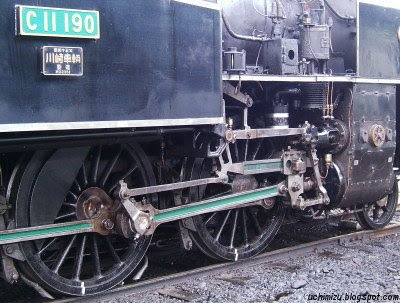
Once arrived to destination, it is worth spending a few minutes looking at those beautiful machines now forgotten, but which were the true engine of the industrial revolution. Those locomotives burn wood or coal in the firebox, and the heat is transmitted to the boiler where it heats water and generates steam. Steam is then heated a second time “superheating” to reach more than 300 degrees and a higher pressure. Then, the steam goes to the piston, where the power is transmitted to the wheels through the rods, a superb mechanism that is entirely visible. Steam locomotives do not have a gear box, and so need large wheels in order to reach high speeds. Our train in the Oigawa valley is quite slow, but the superb “Mallard” British locomotive reached around 200km.h in the 30’s.
You will probably find the trip to Senzu is not enough. You can continue the journey on the second section of the line. A small electric train drives on the narrow and steep track up to the Ikawa (井川) terminal. This is an impressive journey through the mountains, with a beautiful scenic bridge crossing the Nagashima dam lake (長島ダム).
Oigawa valley does not have the tourist infrastructure of nearby Izu Peninsula (伊豆半島), but you may want to combine the pleasures of the steam locomotive with a hike to nearby mountains, and, to make it a full “steam-oriented” day, a visit to the Onsen in the valley. This is definitely worth a full week-end.
Accès to Kanaya from Tokyo : Board the Tokaido Shinkansen Hikari (東海道新幹線ひかり) service to Shizuoka. Be aware that only one Hikari per hour stops in Shizuoka. At Shizuoka, you should change to Tokaido line (東海道本線) bound for Hamamatsu (浜松) and stop at Kanaya (金谷). 6490 Yens, About 2 hours.

Oigawa Railway Company (大井川鉄道):http://www.oigawa-railway.co.jp/

Steam train service between Kanaya and Senzu: Y2370 (14.50 Euro) including Y560 of steam surcharge : the train leaves Kanaya between 10am and noon, all seats are reserved, reservation by phone, internet, or on the day of travel at the station. On weekdays, it should not be necessary to book. The schedule of steam services to Kanaya is not always convenient (departure from Senzu at 14:16 or 15:23 depending on days), but it is also possible to board a regular electric service on the way back. Last departure from Senzu at 19:56 on regular service
.
Ikawa line between Senzu and Ikawa: 5 trains a day, first departure from Senzu at 9:23, last departure at 13:45. Approximately 105 minutes. Last departure from Ikawa at 15:48. line site : http://www.ikawasen.jp/).

A bus service links Senzu station (千図) and Okuizumi station (奥泉) to the nearby SumataKyo onsens (寸又峡温泉). There are plans available combining a stay at the onsen, dinner, breakfast and steam train service for Y9980 to 11980 (60 to 72 Euros).

Model Train shop Tenshodo (天賞堂): 4-3-9 Ginza, Chuo Ku, Tokyo 〒104-0061 東京都中央区銀座4-3-9 TEL:03-3562-0025, open everyday except Thursday from 11:00 à 19:30. Access from JR Yurakucho station (有楽町) or subway Ginza station (銀座).


Full Story