Showing posts with label Shizuoka. Show all posts

Monday, August 4, 2008

Tea, pinetrees by the sea and a great Volcano

Located on the fertile Pacific coast of Japan, just midway between Tokyo and Nagoya, Shizuoka (静岡) is the nineteenth stage of the old Tokaido (東海道) road linking Edo (江戸, now Tokyo東京) to Kyoto(京都). Recent excavations have found a village with rice paddies on Toro (登呂) site, a sign that humans settled the site in early antiquity. More recently, the young Tokugawa Ieyasu (徳川家康) was held as an hostage in Sunpu Castle (駿府城). He was to unify Japan later in his life, and retired in Sunpu after his abdication. Today, Shizuoka is a lively city worth visiting for its outstanding scenery and food.
With 700.000 people calling it home, Shizuoka ranks amongst the 20 first Japanese cities and is well served by modern transport. The shinkansen express service stops in the station every hour. The lively downtown area is just by the station, where department stores, offices and restaurant cluster. Sunpu castle ruins, now converted into a garden, are nearby. The regular Tokaido service stops in the trendy suburb of Kusanagi and in the port of Shimizu in addition to the main station. A small local train (Shizutetsu 静鉄) also links downtown (Shin-Shizuoka station 新静岡) to Shimizu (Shin-Shimizu station 新清水). The locals will tell you proudly that it is not the smallest train in Japan, as it is a genuine double track all along the 11 kilometers of the line, and there is a frequent service of up to one train every five minutes. The most famous industry in the city is toy manufacturing, with a tradition of wooden toy going back centuries ago. The town is home to Tamiya, the famous plastic model manufacturer.
Shizuoka is an interesting stop on the way from Kyoto to Tokyo. The city is built in an outstanding location, and the climate is said to be the warmer of mainland Japan. The town is bordered on the west side by the Abe-Kawa river (安倍川), and on the north side by the foothills of the southern Alps (南アルプス). Shizuoka was build around the Sunpu castle, just north of the station, unfortunately destroyed at the end of Meiji era. It is worth a walk to enjoy the beautiful traditional garden, and the fantastic view from the top of the Prefecture building (free access). One aisle and the main door of the castle were rebuilt in the traditional way, and the moats are well preserved. Shizuoka center ends on Nihon-Daira (日本平) foothills.
Nihon-Daira is classified amongst the hundred beautiful views of Japan (観光地百選). It is an undulating hill covered by forests with beautiful views of Mount-Fuji (富士山) and Shimizu port in the foreground. The famous volcano is only 20 kilometers away, which makes Shizuoka one of the best places to watch the mountain.
From the top of Nihon-Daira, a cable car goes to Kunozan Toshogu (久能山東照宮) shrine, just uphill from the shoreline. It was built just after the death of Tokugawa Ieyasu, in a colorful style close to the one of Nikko that blends well with the tropical vegetation. The shoreline road is a pleasant way to go to Shimizu. The natural port lays in the bay sheltered by the Miho peninsula (三保半島). The peninsula is famous for the superb pine-tree plantations by the beach at Miho-Matsubara (三保松原). It also offers beautiful views of Mount-Fuji. Shimizu harbor was pleasantly renovated around the “Dream Plaza”, a modern shopping center. From the port, ferries leave to Toi, a small port on the Izu Peninsula (伊豆半島).
Shizuoka area has one of the mildest climates in Japan and rich soil, so it can grow some of the best tea of Japan. Numerous hillside fields are located near the Abe-kawa banks and the Nihon-Zaka (日本坂) hill west of the city. Shimizu port has the most important tuna fishing fleet of Japan, and Yaizu (焼津) port, just west of the Abe-kawa is also an important fishing hub. Sushi restaurants in the city have no issue finding excellent supplies. There is even a sushi museum in the Shimizu “Dream Plaza”. The town is also producing tuna preserved in Miso. Suruga Bay ((駿河湾) is famous for its Sakura-Ebi (桜海老), tasty small shrimps that are often fried, but can also be made into crackers (sembe). They can be harvested in April and Novembeer. Shirasu, young shrimps with a strong taste, are also excellent. In early spring, from February to April, « Ichigo-gari » (苺狩り) can be enjoyed in the strawberry fields near the road between Nihon-Daira and the sea. This is an « all you can eat » formula where you pick the fruits directly on the tree in the field.
Ideally located, Shizuoka is an excellent location for a pleasant stop-over between the Hakone / Izu region and Nagoya. The arrival from Toi by ferry well be unforgettable by fine weather.
Practical Information

Access to Shizuoka by Tokaido Shinkansen Hikari service from Tokyo (1h03, Yen 6.380, 40 Euros), or Shin-Osaka (1h50, Yen 10.780, 67 Euros), 1 train every hour; by car : Tomei motorway, Exit at Shizuoka IC or Shimizu IC.

Access to Shimizu: by Tokaido line from Shizuoka station : 10 minutes, Yen 230 (1.40 Euros), by Shizutetsu line from Shin-Shizuoaka : 20 minutes, Yen 290 (1.80 Euros).

Access to Miho: Bus line 57/58 (Miho Yamanote Line, from Shizutetsu company) from Shimizu station or « Dream-Plaza », exit at « Miho-Matsubara Iriguchi (三保松原入り口) bus stop, one bus every 10 minutes.

Access to Nihon-Daira: line 42 (Nihondaira Line, from Shizutetsu company) from Shizuoka station (platform number 13), one bus every hour on week-end, 4 buses a day on week-days, exit on the last stop.

Access to Toro: line 10 (Ishida Kaigan line) from Shizuoka station (platform 4), exit at ToroIsekiIriguchi (登呂遺跡入口).

Nihondaira cable car (access to Kunosan-Toshogu shrine): one car every 15 minutes and 10 minutes on peak hour, return ticket Yen 900 (5.60 Euros), one-way for Yen 500 (3.10 Euros).

It is much more convenient, and often cheaper, to visit the region with a car.

Useful Links

Toshogu Shrine (http://www.toshogu.or.jp/)
Nihon-Daira Cablecar (http://www.shizutetsu.co.jp/park/guide.html#ropeway)
Shizutetsu bus company timetable (http://db.shizutetsu.co.jp/bus/)

An outstanding sushi restaurant in Shimizu: Suehiro Sushi (末廣鮨): lunch from Y2000 (13 Euros), dinner From Y8400 (53 Euros), telephone : +81.54-366-6083 (〒424-0815 静岡市清水区江尻東2-5-28), 5 minutes walk from Shimizu station, open from 11 :30 à 22 :00, closed on Wednesday.
Full Story

Saturday, April 5, 2008

On the tracks of the Izu Dancer

I may not be the only one to have been introduced to Japanese literature by the short “Izu Dancer” (伊豆の踊り子) novel. It tells the story of a young high-school student going on a vacation trip to the Izu Peninsula (伊豆半島) in the early 1900s. He starts the trip alone and sad. Later, he meets a group of entertainers and travels with them down to Shimoda(下田). His mood gets a lot better, thanks to his cheerful company and especially the attraction he feels for a young dancer. The young age of the girl and the gap in social status will not allow him to have an affair, but our hero leaves for Tokyo from Shimoda by boat with much lighter feelings. The story is gracefully told by Kawabata’s elegant prose.
During my first trip to Japan, I ran into Izu Peninsula again when I looked for a quick “onsen experience” outside Tokyo. This brought me to Atami (熱海), the gateway to the Peninsula, and a popular modern resort. Being on budget, I did not go there by the aptly name “Odoriko” (Dancer) Express, and restricted myself to a cheap but pleasant onsen afternoon in a modern hotel, before going back to Tokyo by the regular commuter train and eating cheap ramen noodles again for dinner.
A few years later, I could at least discover more of the Peninsula. The orange and green regular train brought me from Tokyo to Ito(伊東), a small fishing town and a Hot Spring (温泉) resort. I was quite disappointed by the outside aspect of the onsen ryokan (旅館) I booked, which looked more like a Tokyo suburb building than a holiday resort. However, the experience was unforgettable, as the staff was extremely helpful, and I could enjoy a relaxing tatami room. Food in ryokan is also great, with an elaborated dinner and breakfast served in the room. In Izu coast, it almost always includes raw fish, whereas boar (猪) is more common in the mountains. The best of an onsen trip is of course the long evening when there is plenty of time to enjoy the hot and sulphurous water, and to sleep with the whole body relaxed. Some ryokans are also set in old traditional house, with a great atmosphere. Old Japanese buildings however sometimes lack the sound isolation that would be suited in such a favourite date spot.
The coastal road south of Ito is interesting enough for an afternoon stroll, and offers beautiful views of Oshima(大島) islands. However, it is worth taking the train south to Jogasaki Kaigan (城ヶ埼海岸) Station. Nearby is the beautiful shoreline of Jogasaki (城ヶ埼), with its lava cliffs surrounded by pine trees and going straight into the see. The shoreline is beautifully preserved, and offers several kilometres of hikes. Nearby is also the surprising Mount Omura (大室山), a now sleepy small volcano that can be climbed by a chairlift. It offers nice views over the Izu Peninsula, nearby islands, and Mount Fuji. After climbing down the volcano, you could continue to Shimoda, at the southern end of the peninsula, by train. This historical port is where the famous American “black ships” landed in 1858, putting an end to two centuries of almost full isolation for Japan.On the way, you could stop on the famous “Shirahama” (白浜) beach, a popular swimming spot in summer, and a surf spot all year round.
It is however possible to reach Shimoda via the mountain road. This is the way taken by the party in the Izu dancer novel. Your trip will start in Mishima (三島), and should definitely include an Unagi (うなぎ) meal. The eel is grilled over a charcoal fire, with the sauce giving it a sweet flavour. You may also enjoy near Mishima the beautiful Kakitagawa (柿田川) springs. The very pure deep blue water is said to come from Mount Fuji, and the surrounding wetlands are very pleasant.
Back in Mishima, the train will bring you to Shuzenji (修善寺) town in central Izu peninsula. The nearby “Shuzenji onsen” (修善寺温泉) resort is home to some of the most renowned ryokan in Japan. There are also more affordable options, and It is a good place for staying overnight. From Shuzenji, you can travel by bus through the central road that goes down to Shimoda. The Joren waterfalls (浄連の
滝) are certainly impressive, but the best is probably a hike in the Amagi Toge (天城峠) road, now closed to cars. I was lucky enough to hike it during a misty afternoon, and the fog gave a touch of mystery to the forest. I would not have been surprised if the travelling party of the Izu dancer just came out of the fog in front of me. Also impressive was the completely dark tunnel one has to cross at the top of the road. Travelling further down to Shimoda, the road crosses twice a weird loop-shaped bridge, an original and supposedly earthquake-proof way of climbing the mountains.
Another way to travel to Izu from Nagoya or Osaka is the ferry connecting Shimizu (清水) to Toi (土肥). It crosses the Suruga-bay with beautiful views on mount fuji on clear time. A reasonably frequent bus links the small town of Ooi to Shuzenji. Of course, it is possible to board the ferry with a car, and you may avoid the frequent traffic jams around Numazu on week-ends
Practical information:

Access to Atami: Tokaido Shinkansen Kodama(Y4288 - 27 Euro, 46min from Tokyo), Special ‘Odoriko’ Service (Y3900 - 24 Euro, 80min from Tokyo) or Tokaido main line (111 min, Y1890 - 12 Euro from Tokyo). The Odoriko service continues to Ito (Y4420, 104min) and Shimoda (Y6290, 164min). There are also local train services between Atami and Ito (JR Ito line), and between Ito and Shimoda (Izu express line).

Access to Mishima: Tokaido Shinkansen Hikari (Y4600 - 28 Euro, 44min from Tokyo), or Tokaido main line (119 min, Y2210 from Tokyo, train change in Atami)

Access to Shuzenji: Izu Hakone line from Mishima to Shuzenji (33 minutes, 500 - 3 Euro) Frequent buses from Shuzenji station (every 15 minutes) to Shuzenji Onsen resort (Izu Hakone bus or Tokai bus). There are around 20 buses a day between Shuzenji and Toi. Buses bound for Matsuzaki (松崎) stop in Toi.

Access to Joren Fall and Amagi Toge: bus from Shuzenji bound to Kawazu. Approximately one bus every 30 minutes. 30 minutes, Y800 - 5 Euro to reach Joren Fall, Y1060 - 7 Euros, 45 minutes to reach Amani Toge

Access to Toi from Ferry. Dream Ferry from Shimizu. Around 65 minutes, between 4 and 7 return trips a day. The first ferry leaves Shimizu at 8am, and Toi at 9.20 am. The last ferry leaves Shimizu at 4pm and Toi at 5.20 pm. One way trip is Y2000 - 12 Euro per person, and Y4300 - 25 Euro per individual car (less than 3m long).

Izu Hakone bus: http://www.izuhakone.co.jp/bus/rosen/index.htm (In Japanese)
Tokai Bus: http://www.tokaibus.jp/mainroot.html (In Japanese)
Toi bus schedule: http://www.toi-annai.com/access/basu.html (In Japanese)
Toi <-> Shimizu Ferry: http://www.dream-ferry.co.jp/

Unagi Restaurant in Mishima : sakuraya (桜家) 三島市広小路町13-2 hirokoji-cho Mishima. Tel 055-975-4520. Open from 11am to 8pm or when sold-out. Meals from Y2620 - 16 Euros. Closed on Wednesday and holidays.

Booking an onsen hotel or ryokan: Yahoo Japan (http://www.yahoo.co.jp/ offers comprehensive accommodation booking service under the category ‘travel’. The secret Japan (http://www.secret-japan.com/) site offers independent advice in English and in French on Onsen destination, and also includes a guide to west Izu coast.


Full Story

Thursday, March 20, 2008

Trains from a bygone age in Oigawa valley

Japanese people take their hobby seriously, especially when this hobby is train. One famous competition tests the knowledge of the official express train time-table for the whole country. Some extremists will camp for hours near a railroad with a tripod and a zoom lens to take a shot of an unusual formation. There is a great variety of train designs as the numerous companies in Japan usually order a specific model for each of their special service, such as the famous Narita express service between Tokyo and the airport. Railway modelers in Japan also have a great time there, as models are quite cheap, and built to high standards. Salesmen in specialized shops will very seriously advise the customers on their purchase to ensure the result is realistic.
We will go to a railway trip in Oigawa (大井川) valley in Shizuoka (静岡) prefecture, midway between Tokyo (東京) and Nagoya (名古屋). The Oigawa river flows from the Japanese Southern Alps in a narrow valley to the Pacific Ocean 168 km later. Its crossing was one of the back spots of the old Tokaido (東海道) road. The modern history of the valley is centered on hydro-electric power. The railroad we will travel on today was built during the 1920s to move construction material for the dams. The whole line was opened in 1954, just before the Ikawa dam entered into service.
In the sixties, the end of dam construction and the extension of the road network meant traffic declined on the line, and the company only survived thanks to public subsidies. In the seventies, the Japanese national railways retired steam locomotives. The Oigawa railway company (Dai-tetsu大鉄) bought two used steam locomotives (called SL in Japan). Since 1976, they have been powering tourist services on the line. The company was inspired by the « Brienz Rothorn Bahn », which maintained a full steam service on its line. In the 1980, thanks to the numerous tourists, the Oigawa railroad was back in the black. The economic crisis in the 90s meant hard times again for the company, which survived thanks to subsidies from the Central Japan Electricity Company.
Today, the Oigawa line is the only one to ensure an almost daily steam train service, with up to 3 services a day. The train travels on the 40 first kilometers between Kanaya (金谷) and Senzu(千頭). The formation is powered by one of the 5 steam locomotives in service. The coaches are also old, and give a good idea of the limited comfort of train transport decades ago. Before boarding, you may buy a “loco-bento”, an elegantly packed lunch with a steam locomotive decoration, to make sure not to get hungry during the travel. This is a pleasant trip, first traveling through the tea fields, then near the river in the narrow valley. The sound of steam, and the oil smell gives a special flavor to the trip.
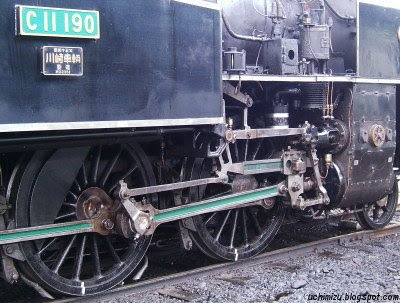
Once arrived to destination, it is worth spending a few minutes looking at those beautiful machines now forgotten, but which were the true engine of the industrial revolution. Those locomotives burn wood or coal in the firebox, and the heat is transmitted to the boiler where it heats water and generates steam. Steam is then heated a second time “superheating” to reach more than 300 degrees and a higher pressure. Then, the steam goes to the piston, where the power is transmitted to the wheels through the rods, a superb mechanism that is entirely visible. Steam locomotives do not have a gear box, and so need large wheels in order to reach high speeds. Our train in the Oigawa valley is quite slow, but the superb “Mallard” British locomotive reached around 200km.h in the 30’s.
You will probably find the trip to Senzu is not enough. You can continue the journey on the second section of the line. A small electric train drives on the narrow and steep track up to the Ikawa (井川) terminal. This is an impressive journey through the mountains, with a beautiful scenic bridge crossing the Nagashima dam lake (長島ダム).
Oigawa valley does not have the tourist infrastructure of nearby Izu Peninsula (伊豆半島), but you may want to combine the pleasures of the steam locomotive with a hike to nearby mountains, and, to make it a full “steam-oriented” day, a visit to the Onsen in the valley. This is definitely worth a full week-end.
Accès to Kanaya from Tokyo : Board the Tokaido Shinkansen Hikari (東海道新幹線ひかり) service to Shizuoka. Be aware that only one Hikari per hour stops in Shizuoka. At Shizuoka, you should change to Tokaido line (東海道本線) bound for Hamamatsu (浜松) and stop at Kanaya (金谷). 6490 Yens, About 2 hours.

Oigawa Railway Company (大井川鉄道):http://www.oigawa-railway.co.jp/

Steam train service between Kanaya and Senzu: Y2370 (14.50 Euro) including Y560 of steam surcharge : the train leaves Kanaya between 10am and noon, all seats are reserved, reservation by phone, internet, or on the day of travel at the station. On weekdays, it should not be necessary to book. The schedule of steam services to Kanaya is not always convenient (departure from Senzu at 14:16 or 15:23 depending on days), but it is also possible to board a regular electric service on the way back. Last departure from Senzu at 19:56 on regular service
.
Ikawa line between Senzu and Ikawa: 5 trains a day, first departure from Senzu at 9:23, last departure at 13:45. Approximately 105 minutes. Last departure from Ikawa at 15:48. line site : http://www.ikawasen.jp/).

A bus service links Senzu station (千図) and Okuizumi station (奥泉) to the nearby SumataKyo onsens (寸又峡温泉). There are plans available combining a stay at the onsen, dinner, breakfast and steam train service for Y9980 to 11980 (60 to 72 Euros).

Model Train shop Tenshodo (天賞堂): 4-3-9 Ginza, Chuo Ku, Tokyo 〒104-0061 東京都中央区銀座4-3-9 TEL:03-3562-0025, open everyday except Thursday from 11:00 à 19:30. Access from JR Yurakucho station (有楽町) or subway Ginza station (銀座).


Full Story