Showing posts with label train. Show all posts

Friday, February 13, 2009

Hakone

The view of Mount-Fuji over Hakone Lake is one of the picture-postcards of Japan. As every tourist spot in the country, Hakone can get overcrowded. People who lined-up for two hours to board the cable card will indeed have a bad memory, especially if they were rewarded with a view on … the clouds in front of the famous volcano. However, outside of the busy period and if the weather is fine, Hakone will be an unforgettable trip only one hour away from Tokyo: the volcanic activity, outstanding views and pleasant hikes will make the perfect getaway to forget about Tokyo. Hakone is a nice place to spend a night. It should be part of any trip of Kanto (Tokyo region) that could also include Nikko, Kamakura, a trip in the mountains and the Izu peninsula.
There is plenty to see and do there, but the trip from Tokyo is also interesting in its own right. The “Romance Car”, a special service of the Odakyu company, offer a few panoramic seat with a direct view on the railroad (the driver’s cabin is elevated in order not to spoil the view). As the train goes through the whole Tokyo suburbs from the major urban center of Shinjuku, this is probably one of the best ways to get an overview of the city. High-rise buildings soon make the way for ordinary suburb condos, with a surprising number of detached houses even close from the city center. Near every station, the urban density increases, with more condos and commercial buildings. There are only a few rice or vegetables fields at first, but at some point, they occupy most of the land, and the typical Japanese countryside landscape appears: small rice fields and always some hours nearby. After crossing a few hills, the train crosses the small town of Matsuda (松田), and Odawara (小田原), before making its way through a narrow valley to Hakone Yumoto (箱根湯本).
Hakone Yumoto is a trendy hot spring (onsen) station from where the Hakone-Tozan (箱根当山) train starts. You may wish to enjoy the Fujiya “Classic Hotel” near Miyanoshita station (宮ノ下駅), which is also an outstanding place just to have a drink or a tea, and you may want to go there just to buy the “Curry Pans”, with a reputation as some of the bests in the country. This is a much quieter place than Hakone Yumoto. Gora station (強羅駅), the final station of the Hakone-Tozan line, is also a nice place to enjoy onsens. There are many isolated hamlets around with one of two onsen hotels for those of you who prefer to be surrounded by nature. If this was not enough for you hotspring-wise, the Izu Peninsula is only a few minutes train from Odawara, especially Atami station, which is now back in fashion.

Hakone is located in a collapsed crater of a volcano, and the famous lake is the lowest point of the resulting “caldeira”. The last eruption was 3000 years ago, and created the lake Ashinoko (芦ノ湖) and the Owakudani valley. Between Hakone Yumoto and Ashiko lake, Owakudani (大涌谷) looks like Hell's gate. Sulphurous smoke gets out from the ground, and there are numerous hot springs. This being Japan, a special souvenir food was created for the place: Black eggs « kurotamago » (黒玉子), are boiled in volcanic smoke. They are supposed to make life 7 years longer if eaten with moderation, a very convenient custom to increase sales. You can reach Owakudani from the cablecar and the ropeway from Gora.
The main reason to come to Hakone is for the outstanding views of Mount-Fuji. They are at their most impressive between the end of Autumn and the start of Spring, when the mountain is still covered with snow, and the weather clear enough to see he volcano. One of the most pleasant places is a garden located on the site of a former imperial residence (onshi-hakone, 恩賜箱根) in a small peninsula halfway between Moto-Hakone (元箱根) and Hakone-machi (箱根町). Following the standard tourist itinerary, Moto-Hakone can be reached from the boat starting near the cable car terminal at Togendai (桃源台). One should be prepared for a reproduction of a French ship of the line, or a Mississippi steam boat, and should remind that eclectics is a very important part of Japanese culture. Once in Moto-Hakone, the garden can be reached by a pleasant 15 minutes walk in a very pleasant alley bordered by old pine trees following the lake shores. This is a section of the historic Tokaido road. After visiting the garden, you can continue your walk on the road heading to Hakone-machi, and you will find the old custom gate of Hakone (HakoneSekisho, 箱根関所). This used to be the entry of the Kanto (literally meaning “east of the gates”) region, and could not be crossed without a special permit. The control of domestic travel was one of the bases of the power of the Tokugawa shogun, who ensured he always had hostages from all the warrior clans in the capital to guarantee internal peace.
From Moto-Hakone, a pleasant trip is the old Tokaido road, called Kyukaido (旧街道), which goes down the mountain to Hakone Yumoto. As may hikes in Japan, it is a pleasant way to enjoy the forest which covers this narrow valley. Hiking boots are compulsory. It can be surprising that the main road of ancient Japan was so narrow, but ancient roads, such as the famous Roman roads, were never actually used to move goods, as this was very costly: business was made by boats on rivers and sea, so roads were used only by travelers and by the army. After one hour of walk, you will come across Amasake-Chaya (甘酒茶屋) which offers welcome warm “sake”, and a small museum presenting the old Tokaido road. After 45 additional minutes, you will reach the small Hatajuku (幡宿) village, which is specialized in wooden boxes, of course sold in many souvenir shops. From the village, you can continue the walk down to Hakone Yumoto (which would take half a day in total), or take the bus to the village.

Practical Information

The Romance Car will set you back Yen 2020 from Shinjuku to Hakone Yumoto, there are approximately two trains per hours. A “free pass” is available to non-residents for Yen 5000 (38 Euros) for 2 days or Yen 5500 (42 Euros) for three days. The company site gives detailed information in English: http://www.odakyu.jp/english/rc/index.html

The classic tourist itinerary from Hakone Yumoto includes the Hakone Tozan train from Hakone-Yumoto to Gora (Yens 390 one-way), then the Hakone-Tozan train to Sounzan (早雲山), and the cable-car (Hakone Ropeway, 箱根ロープウェイ) to Togendai (桃源台) (Yen 1330 (10 Euros) one way, Yen 2340 (18 Euros) return).

Although the trains and cable cars are pleasant, the most convenient way to reach Moto-Hakone is the bus : 40 mintes from Hakone Yumoto (Yen 930 (7 Euros) one way).

Summer should be avoided, as Mount-Fuji will certainly be hidden by the mist. Official Japanese holidays will bring great crowds, so Hakone is also better avoided at that date: golden week from April 28th to May 5th and New years holidays around January 1st.

This map provided by the Japanese tourism Information Bureau is very convenient: http://www.jnto.go.jp/eng/map/009_Hakone.html


The « Secret Japan » site gives many useful tips on hot springs in the region: http://www.secret-japan.com/forum/hakone-(kanagawa-ken)-t18.html

The official Hakone site lists 17 onsen hot springs. (http://www.hakone.or.jp/english/midokoro/onsen.html)

The woodprint shown here is issues from the “53 stages of Tokaido” (東海道五十三次) series from Utagawa Hiroshige (歌川広重)

You may want to continue reading and organizing your trip with those stories about “Classic Hotels”, “Onsens” and the “Izu Peninsula”.

Full Story

Thursday, November 13, 2008

Shitamachi, Tokyo low town

While the hills of the Yamanote (山手) area were housing the Japanese noblemen during the Edo era (16th to 18th century), the plain in the north of Tokyo (東京) was the heart of the plebeian city. Shitamachi (下町), literally “low town” was originally used to designate Nihonbashi (日本橋), Ginza (銀座) and Ueno (上野), but the word now refers to all neighborhoods north of a Shinjuku (新宿) – Ginza (銀座) line. Other cities in Japan also imported the name to designate similarly working class areas. Only a few minutes walk from a subway station is enough to leave trendy and noisy modern Tokyo and dive into those delightful quiet and outmoded area, a perfect cure to the hustle and bustle of the metropolis.
Shitamachi does not offer spectacular tourist sights, but untouched islands of traditional Japanese town with their chaos of small houses often decorated with a few flowerpots. Shops are often as out of fashion as their aging owners. Between the houses, some warehouses and cottage industries are still open for business. The population is usually quite old: most young people overlook those areas as they do not offer all the facilities of modern life despite a far better location than most residential suburbs. A walk in those areas offers a rare glimpse of postwar Japan, a frugal era where the country was not the economic powerhouse it is today. The small size of the houses and cheap layout of the stores is a good reminder of the frugal life of the postwar generation now in retirement. The most pleasant is to walk randomly in the streets. A compass can come in handy to follow a given direction and find back, after a few minutes walk, a major avenue.
An interesting walk starts in Iidabashi (飯田橋). While our goal is to visit the « low city », we will first walk uphill on Kagurazaka street (神楽坂); a quite trendy area in Tokyo, with some kind of French touch. If you feel in adventurous mood, the nearby alleys are certainly worth a visit. After two left turns, we will take on our right the “Waseda Dori” (早稲田通り) avenue, walk in front of the Kagurazaka subway station and continue for around half an hour in this quiet area of Tokyo. Just after the Waseda subway station, we will reach the campus of the most famous Japanese private university: Waseda Daigaku (早稲田大学). It has an excellent academic level, but, just like for American universities, it is also possible for the sons of the rich and famous to enter if they follow the expensive private lessons offered by the university from primary school. At the Nishi-Waseda (西早稲田) crossing, we will turn right and head north to our first objective: the final station of the streetcar Arakawa line (荒川線). This being a post in my blog, you were probably expecting some kind of railway to pop-up and you were right.


This venerable line is one of the two survivors of the streetcars of Tokyo (the other is the Setagaya line). It goes through many low-key areas that are not well deserved by other public transport means. You will need 50 minutes to ride the 13 kilometers of the line going north-westward to the Minowabashi (三ノ輪橋) terminal. This is an excellent way to discover areas that are not mentioned in any tourist guide. On the way, you may want to stop at Otsuka (大塚), and from there visit Sugamo (巣鴨), the shopping center of elderly people, just a train station away. The Rikugien park (六義園) is worth a short stop, as is the surprising Kyu-Furukawa-Teien (旧古河庭園), a surprising upper-class mansion in this otherwise working class neighbourhood. It is worth riding the streetcar up to the terminal station, which has an interesting architecture. Nearby covered streets have a feeling of small-town Japan. Let’s hope this streetcar, who is in competition with the more modern « Fukutoshin » (副都心) and « Nippori – Tonari Liner » (日暮里舎人ライナー) transit systems opened recently will not be retired. Minowabashi is also close to the famous “slum” of Sanya (山谷), which is not a recommended place to go for a walk. Eldery and poor daily workers, almost exclusively males, often working on construction sites, are living there. Contrary to the working class but socially integrated inhabitants of Shitamachi, they may not appreciate your visit.
After a ride on the subway, we are back in Ueno (上野), the most « working class » of the major urban centers in Tokyo. It used to be the arrival station for immigrants from poor areas in the Tohoku region (North East of Japan). It is famous for its park, which contains, in addition to the very nice National Museum, a small Shitamchi Museum. It is close to the south-eastern end of the Ueno pond, just nearby the Keisei (京成) train terminal. From Ueno, it is very pleasant to walk to Yanaka (谷中). To reach it, we will go back to the far end of the Uneo Park, and turn left on the street crossing the park just in front the National Museum. This street goes to the Yanaka cemetery, crossing through one of the quiestest areas in town. It is easy then to reach the Nippori station, and enjoy the small shops of the “Yanaka Ginza” street.
From Ueno, it is only a short trip to Kappabashi (合羽橋). This is a cluster of kitchen ustensil shops, the ideal place to find original or rare kitchen wares. Most shops were built decades ago and are worth a visit even if you do not wish to buy anything. The nearby area has been urbanized for a long time, but is still very “working class”.
Other neighbourhoods are also worth a random walk in the streets. Hongo (本郷) is a quiet oasis just behind the Tokyo Dome. It is also close to Tokyo University campus, that can be reached by a pleasant walk northward. The area east of the campus, just across Hongo-Dori avenue is well preserved, and there are still 3 storeys wooden appartments there, including the famous Hongo-Kan (本郷館, just nearby the address Hongo 6-20本郷6丁目20). Nezu (根津) is also worth a visit. The commercial street follows a small valley and will lead you directly to Nishi-Nippori (西日暮里).
While this is a little bit off-track, the Edo-Tokyo museum is also interesting. The building has a shape that reminds of a dinosaur or some star wars vehicules, but its exhibitions on urban life in the city centuries agowill pleasantly complete a walk in Shitamachi.
Practical Information

The areas presented in this story are certainly worth more than a day of visit.

Shitamachi Museum (下町風俗資料館): 2-1 Ueno Koen, Tokyo, 〒110-0007
台東区上野公園2番1号, : Y300, open every day except Monday and on the new Year, Tel : +81 3 3823 7451, Japanese site. Just nearby Uneo station (JR Yamanote et subway Hibiya (日比谷線) & Ginza (銀座線) lines)

Edo-Tokyo Museum (江戸東京博物館): 1-4-1 Yokoami, Sumida-ku, Tokyo 130-0015, Tel 03-3626-9974, open every day except Monday from 9.30am to 5.30pm et up to 7.30pm on saturday. Entrance fee : Y600. Volonteer guides propose interesting guided visits, and speak a variety of languages. Access by JR Sobu line (総武線) et par subway Oedo line (大江戸線), Ryogoku station (両国), English site.

Toden Arakawasen (都電荒川線) Flat fare : Y160, departures from Waseda (早稲田) or Minowabashi (三ノ輪橋) from 6am to around 11pm, one train every 5 or 6 minutes on peak hours, japanese site. Access to Minowabashi by the Hibiya subway line (日比谷線), Minowa (三ノ輪) station.

Rikugien Park (六義園): Bunkyo-ku, Hon-Komagome, Rokuchome 〒113-0021文京区本駒込六丁目, Open from 9am à 5pm (last entrance 4.30pm), closed between December 29th and January 1st., Entrance fee : Y300. japanese site.Close to JR Yamanote Sugamo and Komagome station, the latter also reachable by the subway Nanboku line.

Kyu-FurukawaTeien Park (旧古河庭園): Nishigahara Ichome, kita-ku, Tokyo 〒114-0024北区西ヶ原一丁目Open from 9am à 5pm (last entrance 4.30pm), closed between December 29th and January 1st., entrance fee : Y150. Japanese site. Close to Komagome and Nishigaoka stations (subway Nanboku line).


Full Story

Monday, July 7, 2008

Tokaido Shinkansen

The old Tokaido road (東海道) linked the imperial town of Kyoto (京都) to Edo(江戸), the former Tokyo(東京) following the Pacific Coast of Japan. It is the most peopled in the country as the weather is warmer than on the side of the Sea of Japan. Today, the Tokaido axis links the three greatest metropolises in Japan: Kanto(関東), Nagoya area (名古屋) and Kansai(関西). With Japan development in the 50s, the need of a large capacity and modern transportation system appeared. Japan invented at that time high-speed train. The line is still in service today, with an unparalleled reputation for speed, punctuality, frequency, security and comfort. The Tokaido Shinkansen is without doubt the best high speed train service in the world.
Back in 1940, Japan felt the need to build new rail tracks on the Tokaido road. Japan uses a narrower gauge (1067mm) that did not allow as much speed as the European trains of the time. In the fifties, the Kodama Express linked Tokyo to Osaka (around 550km) in 6h50 (average speed of 80km/h), wheras in the same period, the French “Mistral” service ran the 863km between Paris and Marseille in 7h10 (average of 120 km/h). The project was however canceled due to the war.
In the fifties, economic development meant the old Tokaido trunk line was close to saturation, as it was also ensuring freight transportation on an axis that did not have a motorway in service. The National Train company first thought was to double the tracks on the old Tokaido line, but it was not easy as the tracks crossed many urban areas, and it would have been necessary to destroy the buildings close the the railroad. So the alternative project of 1940 was started again: the building of standard gauge (1435 mm) tracks dedicated to high speed train. They were naturally called Shinkansen (新幹線) “New trunk lines”. The huge works was completed between 1959 and 1964. Many bridges and tunnels had to be built. Elevated tracks, bridges and tunnels account for around 80% of the track length. Some tunnels, such as Nihonzaka’s (日本坂) in Shizuoka (静岡), were directly reused from the interrupted works of 1940. The trains required an important amount of research, as electric engines of the time generated too much vibration. Technologies from the Japanese Naval Air force were introduced to solve the vibration issue by Tadashi Matsudaira and other aerospace engineers who joined the railways after the war. Thanks to the efficient cooperation of the JNR president Shinji Sogo, and his chief engineering officer Hideo Shima, everything was completed on time for the inauguration en 1964. Travel time between Tokyo and Osaka was reduced to 4 hours in 1964, then 3h10 in 1965. It is now down to only 2h30.
In the eighties, Japan privatized the heavily indebted National Railways. The network was separated in six companies, and the lines was attributed to “JR Central”, also called “JR Tokai” (東海), the company also managing standard lines in the Nagoya and Shizuoka region. Proceeds from the selling of the very profitable Tokaido Shinkansen allowed the debt to be paid back. Even today, part of the profit of the line is used to finance track improvement work in rural parts of Japan. Some people estimate that it represents an additional cost of 30% for the passenger. Since privatization, “JR Central” managed the line very efficiently. There was no casualty or injuries in the 44 years the line was in service. Average delay of trains was less than 6 seconds in 2003, including delays caused by earthquake, typhoons and heavy snowfalls.
There are plans to construct a new line based on ‘maglev’ technology between Tokyo and Nagoya following the mountain route “Chuo” (中央線). The last plans from the “JR Central” company plan an entry into service in 2025, and a test line has already been built in Yamanashi prefecture (山梨).
3 different types of train run on the line: Kodama (こだま) is the local service. There is a station every 20 or 30 km to serve medium-sized towns on the way. It usually runs between Tokyo and Nagoya, and between Nagoya and Osaka. Hikari (ひかり) stops in Hamamatsu (浜松), Shizuoka or Atami (熱海) in addition to the main stations. Nozomi (のぞみ) only stops in main station: Shinagawa (品川), Shin-Yokohama (新横浜), Nagoya, Kyoto and Shin-Osaka (新大阪). During peak hours, there are up to 11 departures every hour.
High-speed train is an high-tech industry with heavy investments. However, the passenger experience is mainly the result of the cabin layout. Shinkansen coaches have rows of 5 seats with a 2 and 3 layout. Seats are always turned so that passengers always face ahead when the train is moving. It is also possible to create a friendlier layout by turning back one row of seats so that groups of 4 or 6 people travel facing each other. Leg space is very large, so that even tall people can seat in comfortably in regular coaches. In comparison, French TGV or airplane economy class is a nightmare. Cabin decoration is simple, with white and beige the dominant colors, and shapes reminding of aircraft cabins. A display on top of the door gives information about the trip, news, and weather forecast. In the last generation trains (N700), passengers have plugs for their laptop and internet wi-fi access. The restaurant car service was discontinued in 2003, but there are trolleys selling coffee, drinks and sandwiches. There are coaches without reservations with free placement so that it is always possible to take a train at the last minute. It is easy to arrive by subway in Tokyo station without tickets, and to board a train departing 5 or 10 minutes later.
The Fare for the 450 kilometers between Shin-Yokohama and Kyoto (2 hours) is Y12890 (80 Euros) for a regular seat on Nozomi service with reservation. On a Hikari service, the same seat would cost Y12590 (78 Euros). A non-reserved seat valid for Hikari and Kodama is Y12080 (75.5 Euros). Children up to 11 years old pay half fare, but there are not that many other discounts. A completely flexible ticket between Paris and Lyon on the TGV is slightly more expensive, at 81.5 Euros, but the quality of service is less impressive (comfort, frequency, punctuality). However, there are more discount fares on the TGV (advanced non-refundable tickets can be bought for 62.90 Euros. However, the Shinkansen fares are also used in Japan to cross-subsidize the rural network, and are more expensive as a result.
Japan Railways has an up-to-date English site.
Full Story

Friday, June 13, 2008

Private train networks in Tokyo

Generations of would-be town planner spent whole days on the American videogame "Simcity", in the shoes of the mayor. The aim is to tax city dwellers, and to develop the town by smartly spending public money. The equivalent game in Japan is called "A-Train", but players are in the role of the president of the local railway company. The goal is then to build train lines, and speculate on land close to the stations, by building office blocks, hotels, supermarkets and even theme parks. This is an excellent symbol of the major role of private railways in the development of Japanese cities. The result is certainly confusing, but those rail suburbs are very convenient and easy to live in. This story gets us to the south-west of Tokyo, at the heart of the “Tokyu” empire, for an impressive lesson of private urbanism.

Keita Kobayashi, a brilliant high school student from rural Japan was admitted in the prestigious Tokyo University where he met Takaaki Kato, a politician later to become prime minister, who took the young Keita under his protection. He spent fifteen years as a civil servant, and was then nominated as the president of the struggling Musashi railway company. He turned it around, and put in service between 1922 and 1938 the four minor lines of the Tokyu network in the close suburbs of Tokyo:
  • Oimachi line between Futago-tamagawa and Oimachi : 10.4 km
  • Ikegami line between Gotanda and Kamata : 10.1 km
  • Meguro line between Meguro and musashi-kosugi : 9.1 km
  • Tamagawa line between Tamagawa and Kamata : 5.6 km

Through an aggressive acquisition campaign, the company, renamed as “Tokyu”, bought the two major lines of the network:
  • Toyoko line between Tokyo and Yokohama in 1939 : 24.2 km
  • part of the Den-enToshi line between Shibuya and Futago-Tamagawa in 1942, extended after the war to Chuo Rinkan: 31.5 km
During the war, Keita Kobayashi bought the other networks of western Tokyo suburbs (Odakyu and Keio), and built part of the Tokyo subway, but the group was dismembered at the end of the war by the American Occupation Authority, and only kept control of the six lines mentioned above.
The company was a major driver of post war urbanism. It was directly involved in the development of the most important new Town in Japan, the “Tama Den-En-Toshi”. In 1953, only 20.000 People were living in the rural zone between Mizunokochi and Chuo Rinkan. Tokyu built the railway line, and recouped its costs by developing areas adjoining the railways. 550.000 people are now settled in the well-regarded area. This operation stayed unique in the history of Japan.
Works did not stop after the war. The network is regularly upgraded. Three lines are connected to the subway network, which allows very convenient through-services from suburban stations to almost everywhere in the city center. The company is current working on two new interconnections, and to increase capacity on a busy section. Upgrades are partially subsidised by public money since the 1970, especially the elevation of tracks, which contributes to road safety.
As early as 1937, the president of Tokyu had the briliant idea of building a department store in its terminal station in Shibuya. The store is still active, and includes the famous “Tokyu Food Show”, a well stocked food supermarket. The group has also created two very famous chain stores: “Tokyu Hands”, a unique do-it-yourself shop, and “book-off”, a second-hand book store.
The company also developed major real estate projects around its stations: the most spectacular is probably the Carrot Tower, a surprising office building in Sangenjaya. It also owns several hotel chains in Japan and overseas, and created a domestic airline, "Japan Air System", now merged into JAL. The company also built the « Izukyu » rail line that offers easy access to one of the most beautiful areas in Japan. Leveraging on its rail infrastructure, it developed a cable company serving around one million households. Diversification went as far as commercials, as Tokyu owns a famous communication agency. In addition to developing its piece of Tokyo suburbs, the company is an engine for the Japanese economy.
Life in Tokyo suburbs is centered on the rail network. Train is the easiest way to commute to work, which is made convenient by the interconnections with the Tokyo underground. Coaches are clean, safe and fully air-conditioned. As it is the company main cash cows, the network is managed very seriously. Overcrowding is less and less an issue, as the capacity is regularly expanded. Car is a marginal transportation mode: wide avenues are rare, there is no parking in the street, and there are tolls on urban motorways.
The first place to go out is the vicinity of the station (around 30 of them on the Toyoko line). Restaurants and shops cluster around, and very often, a supermarket owned by the train company is the best shopping option. Most places are open until 10 pm, so it is very convenient to buy food or essentials on the way back from work. All stations have their taxi stand, and a safe bicycle park, ensuring easy access to those that are living 10 to 20 minutes walk away from the station. Most roads in the vicinity are very narrow, and almost pedestrian. High-rise condos are usually located near the station, where the rents are slightly more expensive.
For a more elaborate shopping, destinations around the suburban rail network are the best option, as access is fast and the fare is cheap, especially as it is also sometimes possible to use the point-to-point rail pass paid by their corporation for office workers. Connection stations developed naturally into fashionable areas with the help from the train company: restaurants, fashionable boutiques and major stores cluster around the stations of Jiyugaoka, Futago-Tamagawa, Sangenjaya and Naka-Meguro. They can be reached from most places in the network in a few minutes.
Most suburban rail networks also serve recreational areas. The Tokyu network is less endowed than others, as the Tamagawa river banks, the exclusive suburb of Den-en-Chofu, and the port of Yokohama are almost the only options for a Sunday walk. However, the company also developed a small amusement park, “Kodomonokuni”, served by a special rail branch. Some private networks deserve major tourist areas like Hakone or Nikko. They often have special services on comfortable coaches bound for those destinations.
For very special shopping, or a night out, most inhabitants of the Tokyu Empire head for Shibuya, the terminal station of the two main lines in Tokyo. The station platforms directly lead to the Tokyu department store, the most simple place to go shopping. Shibuya is also a famous night spot with bars, night clubs, and its famous "love hotel hill". Modern Tokyo was developed around those suburban rail terminals. The likes of Ueno, Shinjuku, Ikebukuro and Shibuya are dynamic downtown areas, each of them comparing well with European or American cities.
Urbanism based on train has many advantages: a car is not necessary even in the suburbs. Station surroundings are lively commercial areas. Transport is safe, fast and air-conditioned on the whole network. This way of life seems perfectly suited for a 21st century that needs to limit its environmental impacts.
Fares and Travel times :
  • Shibuya – Yokohama : Y260 (1.65 Euro), 30 minutes, 24.2 km
  • Shibuya – Jiyugaoka : Y150 (0.93 Euro), 11 minutes, 7km
  • Shibuya – Chuo-Rinkan: Y320 (2 Euro), 38 minutes, 31.5 km
  • Kamata – Gotanda: Y190 (1.18 Euro), 23 minutes, 10.1 km
  • Kamata – Tamagawa: Y150 (0.93 Euro), 10 minutes, 5.6 km
  • Oimachi, Futago-tamagawa : Y190 (1.18 Euro), 22 minutes, 10.4 km
  • Meguro – Musashikosugi : Y190 (1.18Euro), 19 minutes, 9.1 km
  • Sangenjaya – Shimotakaido : Y140 (0.87 Euro), 17 minutes, 5 km

Interconnections between suburban trains and subway:
  • Hibiya subway line from Naka-Meguro on the Toyoko line
  • Nanboku subway line from Meguro station on the Meguro line
  • Mita subway line from Meguro station on the Meguro line
  • Hanzomon subway line from Shibuya on the Denentoshi line
  • Minatomirai subway line in Yokohama from Yokohama station

Full Story

Thursday, March 20, 2008

Trains from a bygone age in Oigawa valley

Japanese people take their hobby seriously, especially when this hobby is train. One famous competition tests the knowledge of the official express train time-table for the whole country. Some extremists will camp for hours near a railroad with a tripod and a zoom lens to take a shot of an unusual formation. There is a great variety of train designs as the numerous companies in Japan usually order a specific model for each of their special service, such as the famous Narita express service between Tokyo and the airport. Railway modelers in Japan also have a great time there, as models are quite cheap, and built to high standards. Salesmen in specialized shops will very seriously advise the customers on their purchase to ensure the result is realistic.
We will go to a railway trip in Oigawa (大井川) valley in Shizuoka (静岡) prefecture, midway between Tokyo (東京) and Nagoya (名古屋). The Oigawa river flows from the Japanese Southern Alps in a narrow valley to the Pacific Ocean 168 km later. Its crossing was one of the back spots of the old Tokaido (東海道) road. The modern history of the valley is centered on hydro-electric power. The railroad we will travel on today was built during the 1920s to move construction material for the dams. The whole line was opened in 1954, just before the Ikawa dam entered into service.
In the sixties, the end of dam construction and the extension of the road network meant traffic declined on the line, and the company only survived thanks to public subsidies. In the seventies, the Japanese national railways retired steam locomotives. The Oigawa railway company (Dai-tetsu大鉄) bought two used steam locomotives (called SL in Japan). Since 1976, they have been powering tourist services on the line. The company was inspired by the « Brienz Rothorn Bahn », which maintained a full steam service on its line. In the 1980, thanks to the numerous tourists, the Oigawa railroad was back in the black. The economic crisis in the 90s meant hard times again for the company, which survived thanks to subsidies from the Central Japan Electricity Company.
Today, the Oigawa line is the only one to ensure an almost daily steam train service, with up to 3 services a day. The train travels on the 40 first kilometers between Kanaya (金谷) and Senzu(千頭). The formation is powered by one of the 5 steam locomotives in service. The coaches are also old, and give a good idea of the limited comfort of train transport decades ago. Before boarding, you may buy a “loco-bento”, an elegantly packed lunch with a steam locomotive decoration, to make sure not to get hungry during the travel. This is a pleasant trip, first traveling through the tea fields, then near the river in the narrow valley. The sound of steam, and the oil smell gives a special flavor to the trip.
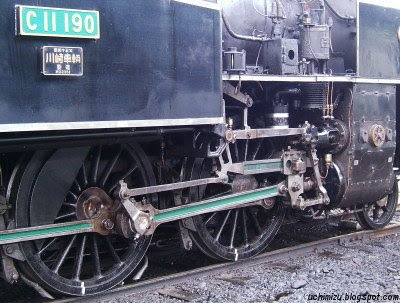
Once arrived to destination, it is worth spending a few minutes looking at those beautiful machines now forgotten, but which were the true engine of the industrial revolution. Those locomotives burn wood or coal in the firebox, and the heat is transmitted to the boiler where it heats water and generates steam. Steam is then heated a second time “superheating” to reach more than 300 degrees and a higher pressure. Then, the steam goes to the piston, where the power is transmitted to the wheels through the rods, a superb mechanism that is entirely visible. Steam locomotives do not have a gear box, and so need large wheels in order to reach high speeds. Our train in the Oigawa valley is quite slow, but the superb “Mallard” British locomotive reached around 200km.h in the 30’s.
You will probably find the trip to Senzu is not enough. You can continue the journey on the second section of the line. A small electric train drives on the narrow and steep track up to the Ikawa (井川) terminal. This is an impressive journey through the mountains, with a beautiful scenic bridge crossing the Nagashima dam lake (長島ダム).
Oigawa valley does not have the tourist infrastructure of nearby Izu Peninsula (伊豆半島), but you may want to combine the pleasures of the steam locomotive with a hike to nearby mountains, and, to make it a full “steam-oriented” day, a visit to the Onsen in the valley. This is definitely worth a full week-end.
Accès to Kanaya from Tokyo : Board the Tokaido Shinkansen Hikari (東海道新幹線ひかり) service to Shizuoka. Be aware that only one Hikari per hour stops in Shizuoka. At Shizuoka, you should change to Tokaido line (東海道本線) bound for Hamamatsu (浜松) and stop at Kanaya (金谷). 6490 Yens, About 2 hours.

Oigawa Railway Company (大井川鉄道):http://www.oigawa-railway.co.jp/

Steam train service between Kanaya and Senzu: Y2370 (14.50 Euro) including Y560 of steam surcharge : the train leaves Kanaya between 10am and noon, all seats are reserved, reservation by phone, internet, or on the day of travel at the station. On weekdays, it should not be necessary to book. The schedule of steam services to Kanaya is not always convenient (departure from Senzu at 14:16 or 15:23 depending on days), but it is also possible to board a regular electric service on the way back. Last departure from Senzu at 19:56 on regular service
.
Ikawa line between Senzu and Ikawa: 5 trains a day, first departure from Senzu at 9:23, last departure at 13:45. Approximately 105 minutes. Last departure from Ikawa at 15:48. line site : http://www.ikawasen.jp/).

A bus service links Senzu station (千図) and Okuizumi station (奥泉) to the nearby SumataKyo onsens (寸又峡温泉). There are plans available combining a stay at the onsen, dinner, breakfast and steam train service for Y9980 to 11980 (60 to 72 Euros).

Model Train shop Tenshodo (天賞堂): 4-3-9 Ginza, Chuo Ku, Tokyo 〒104-0061 東京都中央区銀座4-3-9 TEL:03-3562-0025, open everyday except Thursday from 11:00 à 19:30. Access from JR Yurakucho station (有楽町) or subway Ginza station (銀座).


Full Story